Final Evaluation – Guidance
The final evaluation must reflect on the whole project, not a single outcome, task, or area of work.
It must explain how ideas, planning, research, skills, tools, decisions, and evaluation developed across the entire project.
The evaluation must be written on the homepage of the blog.
Length and format
- Around 5–8 short paragraphs
- Written in full sentences
- Clear, reflective, and written in your own words
Final Evaluation – Questions to Address
All questions below should be addressed, considering the project as a whole.
1. Initial Idea & Project Planning
- Where did the overall project idea come from?
- What was the starting concept for the project?
- What influenced the initial direction of the project?
- How was the project planned at the beginning?
- How was time and workload organised across the project?
- What was planned to be completed first, during the middle, and at the end?
- What was the main aim of the project overall?
- How did planning support the development of the project?
2. Research → Idea Development
- What research was carried out for the project?
- Why were these research sources chosen?
- What ideas came directly from the research?
- What information or understanding was gained from the research?
- How did research influence different parts of the project?
- How did research help connect ideas across the project?
- How did research shape decisions made later in the project?
3. Development & Changes During the Project
- How did ideas develop as the project progressed?
- What aspects of the project did not work at first?
- What problems or limitations were identified during production?
- What changes were made to improve the project?
- Why were these changes necessary?
- How did testing or reviewing work lead to improvements?
- How did these changes affect the final outcomes?
4. Tools, Materials & Techniques
- What tools, materials, or techniques were used across the project?
- Why were particular tools or techniques selected?
- How were different tools used for different parts of the project?
- What skills were already developed before the project began?
- What new skills were learned or improved during the project?
- What technical or practical challenges occurred?
- How were these challenges resolved?
5. Evaluation During the Project
- How was work reviewed during the project?
- What strengths and weaknesses were identified through evaluation?
- How did feedback, testing, or self-review influence decisions?
- What changes were made as a result of evaluation?
- How did evaluation support improvement across the project?
- How did evaluation influence later stages of work?
6. Final Outcomes & Overall Reflection
- What worked well across the project as a whole?
- What strengths are visible when viewing the project overall?
- How do the different outcomes connect together?
- How consistent is the project in terms of theme, style, or idea?
- How does the project function as one complete body of work?
- How does the project relate to real-world creative practice or industries?
7. Improvements & Targets
- What could be improved if the entire project were repeated?
- What aspects of planning could be improved?
- What skills or processes could be developed further?
- What workflow changes could improve future projects?
- What is one clear and realistic target for the next project?
Key reminders
- The evaluation must reflect on the entire project
- It must not focus on a single outcome or task
- Links across all parts of the project must be clear

Use of AI and Academic Integrity
All submitted evaluations will be checked using Turnitin, including its AI writing detection tools. The final evaluation must be written in the your own words and reflect your own thinking, decisions, and experience of the project.
AI tools may be used for support (for example, checking spelling, asking how to improving clarity, or understanding how to structure an evaluation), but they must not be used to generate written content.
Submissions that show evidence of AI-generated writing or that do not reflect the student’s own work may be investigated under academic integrity procedures.
Example of good Final Evaluation:
For Project 2, Dreams, the idea didn’t really start through my college research, it was more from things I already liked as a child. I’ve always been a big fan of retro games like Mario World on the Nintendo SNES, King kong too, and the way those games feel kind of unreal and like you would travel to a different world, like you remember them better than they actually were. That’s basically where my dream idea came from, and it wasn’t really from research at first, and it wasn’t about trying to make something realistic either, but more about wanting it to feel strange and exaggerated and a bit unreal. At the start of the project, and before I really started drawing properly, I took screenshots from Mario World and I used the eyedropper tool in Photoshop and picked colours straight from the game, and then from those colours I made a colour palette, and this palette became like the base of everything I did after, but also helped keep the style consistent from the beginning even when the project started changing. I then created a colour palette using those colours, which became the base for the whole project and helped keep the style consistent from the start.. That’s why I designed a carnivorous plant with a huge tongue moving up and down and back and front, because in a dream things don’t make sense but they still feel right and dreamy and it’s very related in style and concept to the games I mentioned before. The character is recognisable as a plant, but at the same time it’s not something you would see in real life, which for me links directly to the theme Dreams.
The idea also connects to the previous project, Botanical. I was already interested in plants, so instead of changing subject completely, I decided to push that further and turn a plant into a character. By looking back at my Botanical sketches and experiments, I could already see organic shapes that could be pushed further through exaggeration and movement. At first, I was thinking more about illustration, but during the project I realised that without movement the idea was not fully working. After testing a few static versions of the character, it felt too flat and not dream-like enough. So the focus changed more towards animation. This change happened naturally as I tested things, and I think it helped the project become stronger.
For research, I looked at retro platform games and how characters are designed to be simple but expressive. In games like Mario World, characters are designed with very clear silhouettes so they are readable even when moving quickly. I paid attention to shapes, colours, and how movement is used instead of detail. I also looked at animated plants in games and cartoons. From these references, it became clear that exaggerated motion often communicates character better than realistic detail. From this research, I learned that strong silhouettes and clear movement are more important than realism. This helped me decide to keep my character simple in shape but bold in colour. The research was useful because it guided my decisions, not just visually but also technically.
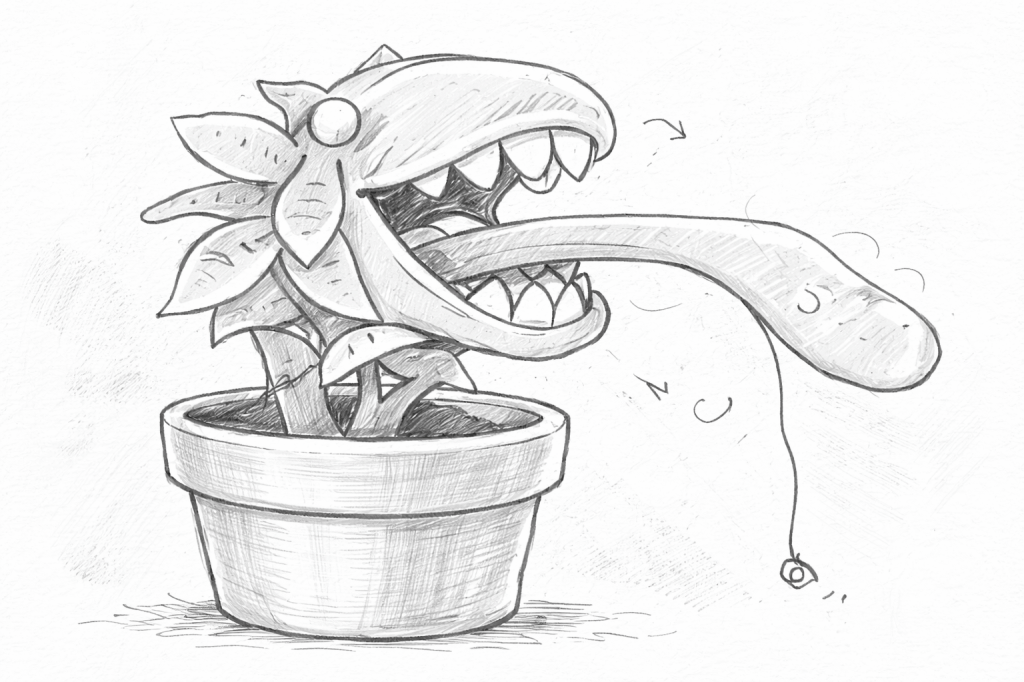
I created the work using Photoshop. During the planning stage, and before everything was fully decided, I was using rough sketches and layer tests and also some short animation experiments just to see how the character could move, and because I already knew how to draw digitally and use different brushes that part wasn’t really a big problem, but the main issue ended up being the animation itself.
Drawing everything frame by frame and layer by layer would honestly take forever and I knew I wouldn’t finish on time, and because of the limited time but still wanting the animation to look good, I had to rethink the way I would animate the character, and that’s why I decided to use Puppet Warp.
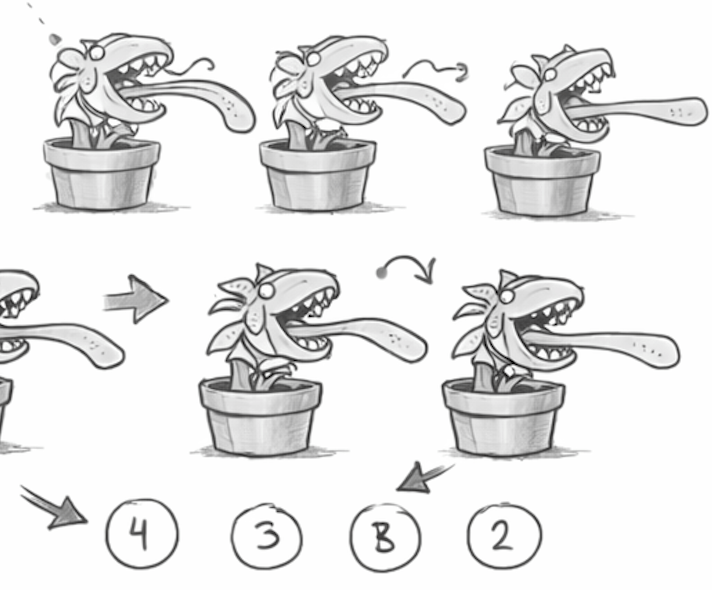
This allowed me to animate the plant and especially the tongue without redrawing everything. At first the movement looked weird and too stiff, and the base of the plant was moving when it shouldn’t, and this was happening because the Puppet Warp pins were placed too close together and also not enough pins were locking the base in place, but I didn’t really notice this straight away and only after watching the animation a few times, and then going through it frame by frame, it became easier to see where the movement was actually breaking and looking wrong, and which parts was moving when they didn’t really need to, so to fix it I had to reposition the pins, add more pins around the base to stop it from stretching, and reduce the amount of movement on the tongue, and after testing different versions and adjusting the pins again and again the movement became smoother, more controlled, and the plant finally felt more natural and believable instead of stiff and broken.
In the end, I think the animation was successful. Comparing the final animation with my early tests helped me see how much the movement and timing had improved. The character feels alive and playful, and the movement supports the dream-like idea. It also feels like something that could exist inside a real game, which makes the project more connected to the real world and creative industries like game design and animation. Time-wise, I managed it well by choosing the right technique, even though earlier testing would have helped.
If I did this project again, I think I’d plan the animation side earlier, because that would save time later on. I’d also try adding more secondary movements so the animation feels more natural and less stiff. For example, I could have added a saliva droping from the tongue or some flies around the plant. Going forward, for my next projects, my main target is to keep improving my animation workflow and get better at combining drawing with movement; using both frame by frame animation and keyframes with photoshop or Blender. Overall, I’m happy with the final result I have got and I feel it meets the project brief to a very high level.
Why this is a strong final evaluation
This evaluation works well because it is clear, focused, and specific.
Each paragraph explains ideas, decisions, and development across the whole project, not just the final outcome.
The writing is easy to follow and stays on topic.
Even when ideas are complex, they are explained in a way that makes sense.
What this evaluation does well
1. Ideas are clearly explained
The evaluation explains where the idea came from and why it fits the theme.
It does not assume the reader already understands the concept.
Example:
“I’ve always been a big fan of retro games like Mario World on the Nintendo SNES…”
This clearly explains inspiration and context.
2. Planning is shown through actions
Planning is not just mentioned — it is shown through specific methods.
Example:
“I took screenshots from Mario World and used the eyedropper tool in Photoshop to pick colours…”
This shows how planning was done and how it influenced the project.
3. Research is used to make decisions
Research is linked directly to design choices.
Example:
“characters are designed with very clear silhouettes so they are readable even when moving quickly”
This shows understanding of research, not just description.
4. Tools and techniques are justified
The evaluation explains why certain tools were chosen and how problems were solved.
Example:
“Drawing everything frame by frame… would take forever… that’s why I decided to use Puppet Warp.”
This shows decision-making, not just tool use.
5. Reflection happens throughout the project
The evaluation explains how testing and reviewing helped improve the work, not just at the end.
Example:
“only after watching the animation a few times, and then going through it frame by frame…”
This shows ongoing evaluation and improvement.
Writing expectations
A strong evaluation should:
- be clear and easy to understand
- stay focused on explanation
- use full sentences
- avoid unnecessary repetition
The goal is clear communication, not writing as much as possible.
If the reader can clearly understand:
- what decisions were made
- why they were made
- how the project improved
then the evaluation is doing its job.
Key reminder
Quality is shown through clear explanation, not long or complicated writing.
Short, well-explained points are stronger than long, unclear ones.
This evaluation works because it explains the journey of the project clearly, from idea to outcome.
That is what is expected for a high-level final evaluation.
 Art & Design @ West Thames College